

Turning the Entire Web into a Watchlist
Today's featured startup lets teams monitor the whole internet through custom queries instead of endless manual checks

Project Overview

Gowatch is an internet monitoring platform that tells you what actually matters has changed across the web — based on what you explicitly ask it to track.
You start by describing, in plain language, what you want to monitor. For example: startups that have just raised seed funding.
Next, you define how often the platform should check for updates — say, daily — and what exactly it should report back. This could include the startup’s name, the funding amount, and links to the founders’ LinkedIn profiles.
After that, you can relax and simply review curated lists of matching startups on the Gowatch dashboard.

Monitoring queries can be made public, in which case they appear in the platform’s template catalog. Anyone can use the results of these public templates. You can also take an existing template and customize it — adding new criteria to create your own public or private monitoring setup.
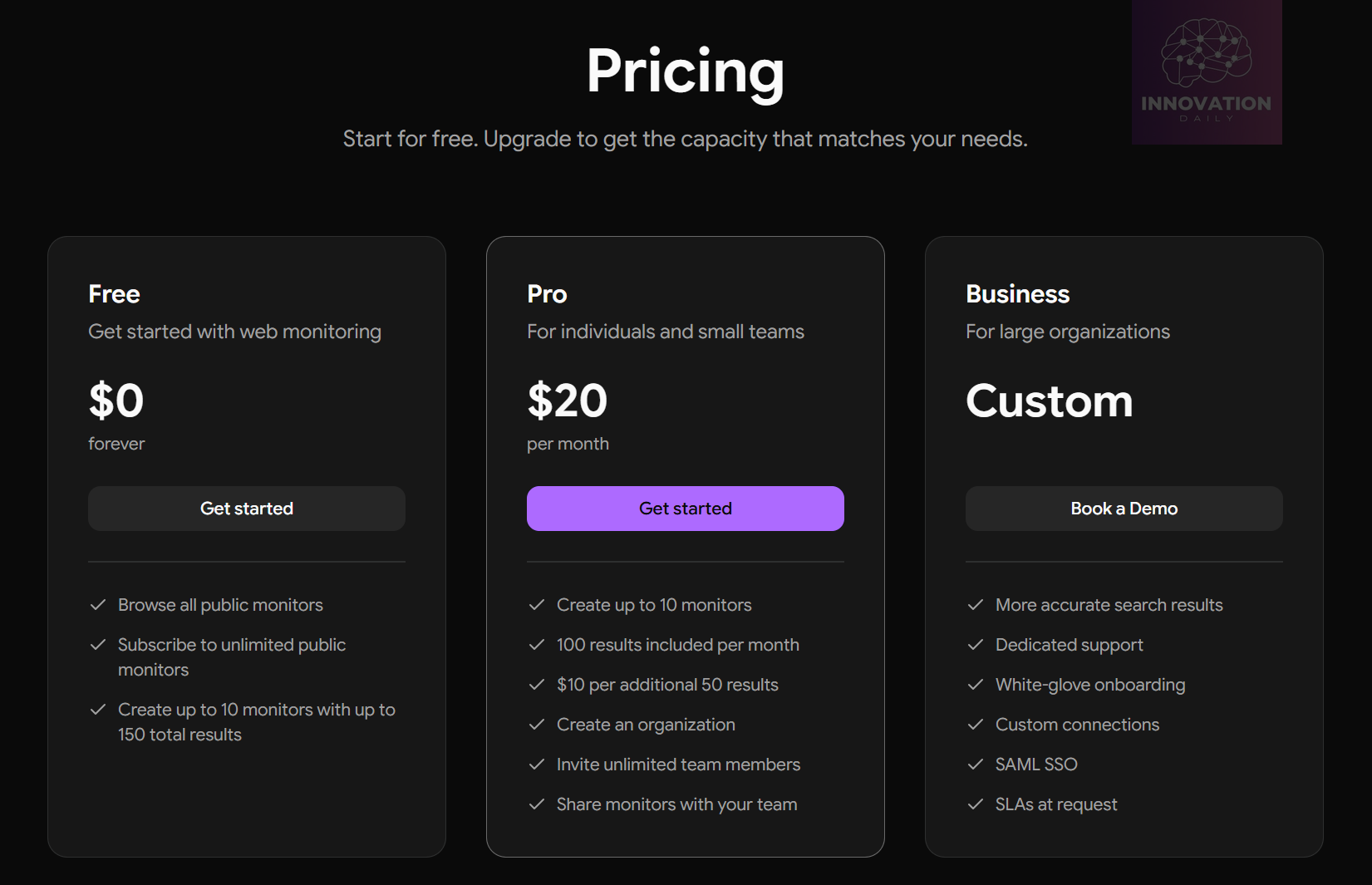
The free plan gives access to public template results and allows up to 10 custom monitoring queries with a total of 150 results.
For $20 per month, users still get 10 monitoring queries, but with up to 100 results, and can purchase an additional 50 results for $10. Pricing for heavier usage is available directly from the startup.
Gowatch graduated from Y Combinator in the spring of last year, although the official launch announcement appeared on the YC website only in December.
What’s the Gist?

At first glance, this kind of monitoring might seem almost “toy-like.” But there’s already a strong precedent in the market.
Take Visualping, a startup that built a more advanced platform for monitoring changes on websites — such as competitors’ sites, regulators’ pages, or other critical sources. Today, Visualping is used by over 2 million people and has raised $8.5 million in funding.
That said, Visualping’s last funding round was back in 2021. In recent years, the company focused on integrating emerging AI tools that began gaining traction in 2022. In November, it launched a new AI-powered monitoring product under the slogan “cut through the web noise.”
The reason is simple: naïve website monitoring — tracking literal changes in page content — often performs poorly. Many detected changes are technical, cosmetic, or too minor to carry any real signal. The arrival of accessible, high-quality AI tools opens the door to a completely new level of relevance and precision for such platforms.
Still, even with AI, this remains a technically challenging problem.

There’s an entire startup, DeepScout, which raised €600,000 last year to solve just one narrow task: monitoring competitors’ price lists for assortment and pricing changes.
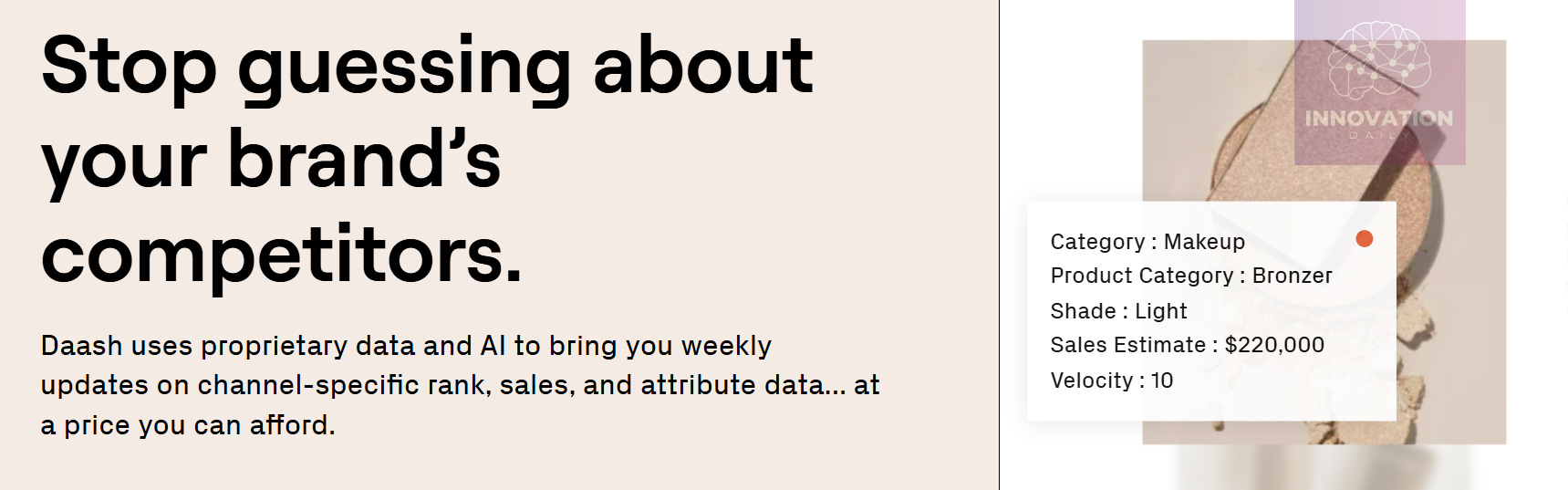
Another example, Daash, went even further by narrowing its target market while deepening its insights. The platform is built specifically for cosmetic brands, enabling them not only to track competitors’ prices and assortments, but also to estimate revenue and even sales performance of individual products. To achieve this, Daash combines AI algorithms with focus group surveys, cross-referencing both data sources. The startup has raised $8.3 million in total, including $5.5 million at the beginning of last year.
The key conceptual difference between Gowatch and its closest analogue, Visualping, is scope. Visualping monitors changes on specific user-defined websites. Gowatch monitors the internet as a whole, extracting relevant information from multiple sources.

This naturally points to an obvious direction for future development: expanding beyond websites to other types of data sources. These could include specialized databases such as company registries or industry-specific datasets — which exist in nearly every sector.
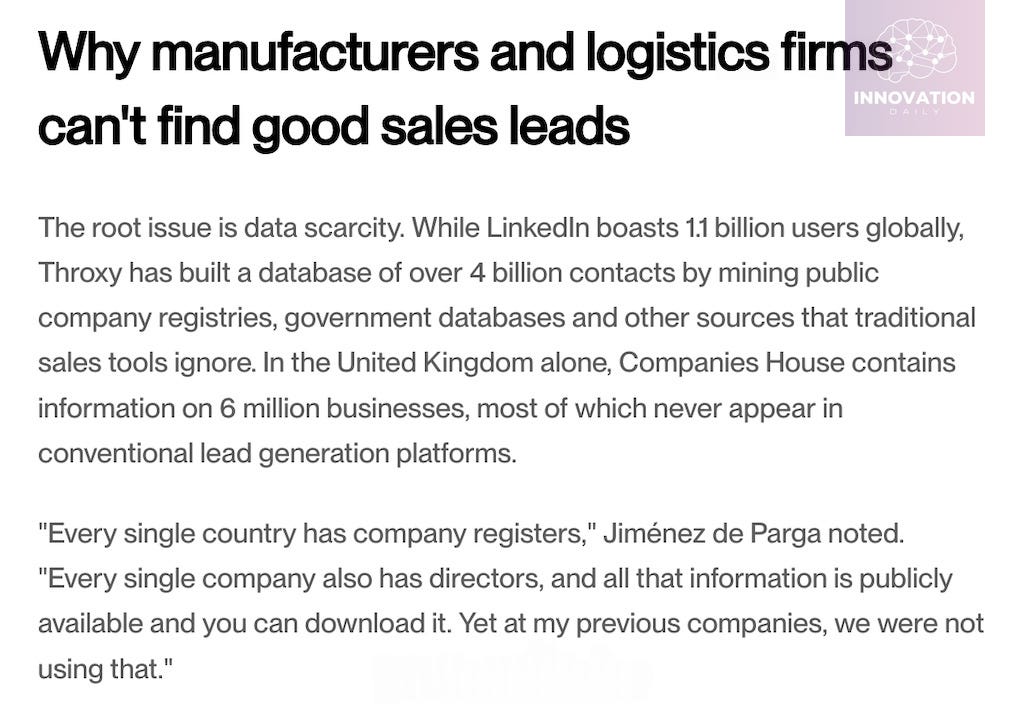
This is a massive opportunity in itself. Entire startups are already built around analyzing such sources to surface hard-to-find potential customers.
For example, Throxy raised $6.2 million last September for a platform that helps companies identify SMB clients in markets that are difficult to analyze using traditional methods — precisely by leveraging specialized and industry-specific databases.
Key Takeaways
No company or startup exists in a vacuum. Teams can focus endlessly on internal strategy or product improvements — but they still need to understand what’s happening in the market and among competitors to respond quickly and effectively.
In theory, tools for monitoring websites, the broader internet, and specialized industry databases should be a must-have for every company.
In practice, adoption remains limited. These tools are often not effective enough.
They don’t cover all relevant sources, ignore specialized databases, lack analytical depth, and generate too much “white noise.”
This is exactly where AI can start to change the game.
If AI reduces this friction, the market for monitoring tools could grow by tens or even hundreds of times — simply by making these products genuinely useful.
At the same time, general-purpose AI chatbots like ChatGPT are not the solution. They’re not designed to guarantee the required level of completeness, accuracy, and freshness. What’s needed instead are specialized AI monitoring tools — potentially very narrow ones — that can deliver much higher precision, depth, and relevance.
Building such AI-powered monitoring systems is a highly promising direction. If quality improves dramatically, adoption can follow just as dramatically.
So ask yourself:
What information in your domain would you like to monitor?
Why aren’t you doing it today?
What’s missing in existing tools?
And how could AI fix or improve that?
The most practical answer is simple:
build such an AI tool for yourself first. If it turns out to be useful for you — chances are, it will be useful for many others as well.
Company Info
Gowatch
Website: gowatch.ai
Total funding: $500K across 1 round